Written by David Platt
Summary:
Hypoxia and ischemia are closely related medical terms, but they describe different problems. Both can interfere with normal tissue function and, when severe or prolonged, can lead to tissue injury.
The terms are often confused because blood flow and oxygen delivery are closely connected. When blood flow falls, tissues may receive less oxygen. However, a person can develop hypoxia without having a problem with blood flow.
The simplest way to remember the distinction is:
Understanding the difference matters because the underlying causes and treatments can be very different. This article explains hypoxia vs ischemia, how the two conditions are connected, common causes, effects on the body, and real-world examples.
Hypoxia occurs when tissues do not have enough oxygen available to meet the needs of their cells.
Oxygen reaches tissues through the bloodstream, but several problems can interfere with that process. A person may have low oxygen in the blood, reduced oxygen-carrying capacity, or a problem that prevents cells from using oxygen normally.
Importantly, hypoxia does not necessarily mean that blood flow has stopped. Blood may still be reaching the tissue while the amount of usable oxygen is inadequate.
Common causes of hypoxia include:
If hypoxia is mild or short-lived, tissues may recover once adequate oxygen is restored. More severe or prolonged oxygen deprivation can interfere with cellular energy production and eventually cause tissue injury.
Ischemia occurs when blood flow to a tissue or organ is inadequate.
Because blood carries oxygen, glucose, and other nutrients, reduced circulation can quickly become an oxygen-delivery problem. But ischemia involves more than oxygen deprivation alone.
When blood flow is restricted, affected cells may receive fewer nutrients and may also have difficulty removing metabolic waste products.
Common causes of ischemia include:
The effects depend on where the reduced blood flow occurs. Ischemia affecting the heart, brain, intestines, or limbs can become particularly serious if circulation is not restored.
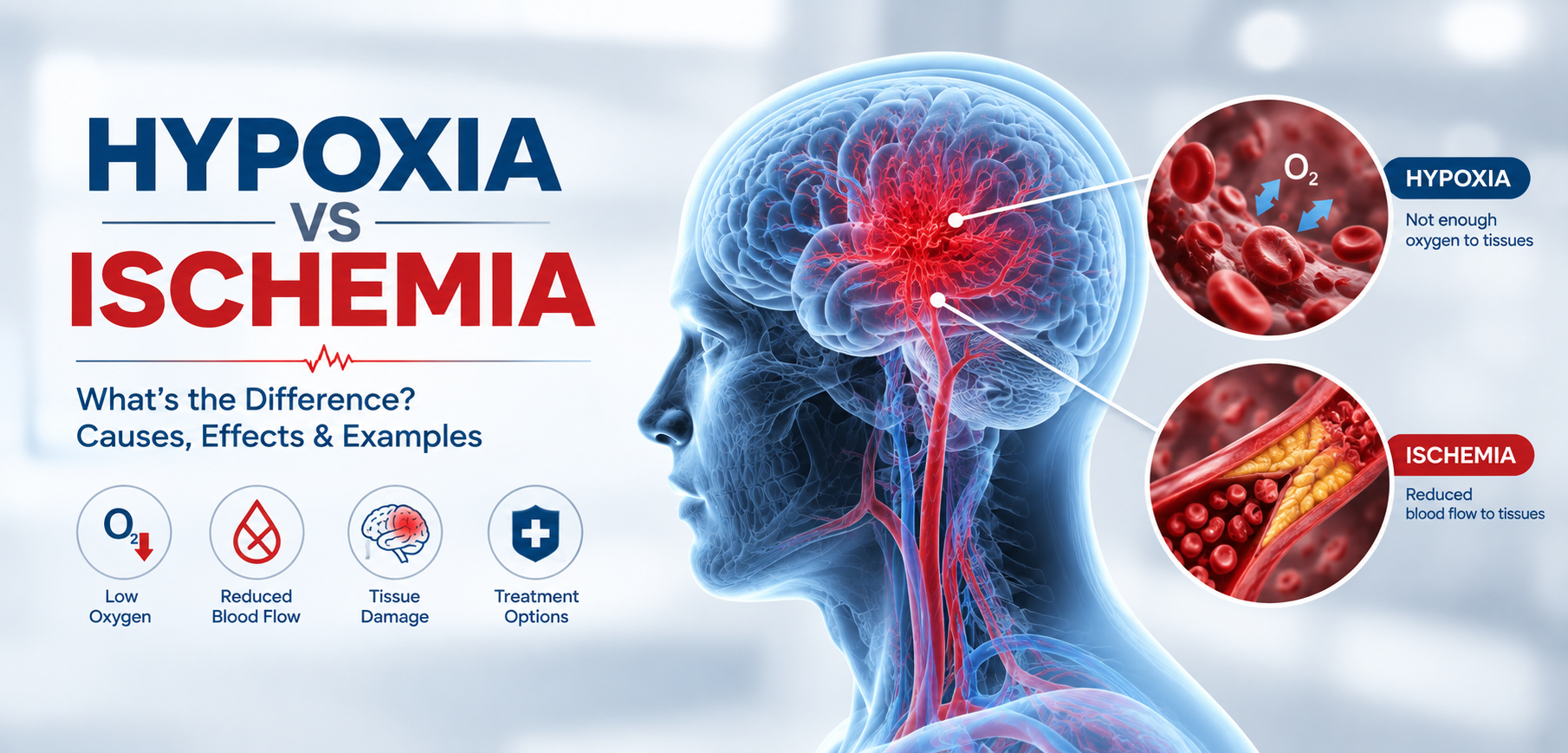
The primary difference between hypoxia and ischemia is what is impaired.
Hypoxia refers to inadequate oxygen availability or use at the tissue level.
Ischemia refers to inadequate blood flow to a tissue or organ.
The two conditions frequently occur together. When an artery becomes blocked, for example, less blood reaches the affected tissue. This reduces the delivery of oxygen and nutrients, potentially causing tissue hypoxia.
However, hypoxia can occur without ischemia. A person at high altitude may have reduced oxygen availability even though blood is still circulating normally. Similarly, anemia can reduce the amount of oxygen the blood can carry without causing an arterial blockage.
Blood flow is one of the most important factors determining how much oxygen reaches a tissue.
When circulation is adequate, oxygenated blood continuously reaches cells and supplies them with what they need for energy production. If blood flow is significantly reduced, oxygen delivery can fall even if the oxygen content of the blood itself is normal.
This is why ischemia can lead to hypoxia.
For example, when a coronary artery becomes severely narrowed, less blood reaches part of the heart muscle. The affected tissue may receive less oxygen and nutrients, creating a state of ischemia that can also produce tissue hypoxia.
Ischemia can cause additional problems beyond low oxygen. Reduced circulation can limit glucose and other nutrients while allowing metabolic waste products to accumulate.
As a result, prolonged ischemia can cause cellular dysfunction and eventually irreversible tissue damage.
These three terms describe different parts of the oxygen and circulation process.
Hypoxemia means that oxygen levels in arterial blood are abnormally low.
Hypoxia means that tissues do not have enough oxygen available or cannot use oxygen effectively.
Ischemia means that blood flow to a tissue or organ is inadequate.
They can overlap, but they should not be treated as interchangeable terms.
For example, severe lung disease can cause hypoxemia, which may then reduce oxygen availability to tissues and contribute to hypoxia. On the other hand, a blocked artery can cause ischemia and tissue hypoxia even when oxygen levels in the arterial blood are normal.
Although hypoxia and ischemia can occur together, their causes are not always the same.
Hypoxia can develop when there is not enough oxygen entering the bloodstream, when blood cannot carry enough oxygen, or when cells cannot use oxygen properly.
Common causes include:
Ischemia is primarily a circulation problem.
Common causes include:
The location of the blood-flow problem often determines the symptoms and potential complications.
Both hypoxia and ischemia can interfere with normal cell function. The effects depend on how severe the problem is, how long it lasts, and which tissue is affected.
When tissues do not receive enough oxygen, cells may have difficulty producing the energy required for normal function.
Possible effects include:
The brain and heart are particularly dependent on a continuous oxygen supply. Significant oxygen deprivation can therefore become dangerous quickly.
Because ischemia restricts blood flow, its effects can involve both oxygen deprivation and loss of nutrient delivery.
Possible effects include:
Symptoms depend heavily on the affected organ. For instance, heart ischemia may cause chest discomfort, while reduced blood flow to a limb may cause pain, weakness, or changes in skin appearance.
Ischemia can be particularly harmful because it disrupts several functions at once.
Reduced blood flow means cells may receive:
At the same time, metabolic waste may not be removed efficiently.
If circulation remains severely restricted, cells can become damaged and eventually die. The longer the ischemia lasts, the greater the risk of permanent tissue injury.
Looking at real-world situations can make the difference easier to understand.
At high altitude, the surrounding air contains less available oxygen than at sea level.
A person may therefore experience reduced oxygen availability even though blood is still circulating through the body's tissues and there is no blocked artery.
This is an example of hypoxia without ischemia.
The body can make physiological adjustments to compensate for lower oxygen availability, but rapid exposure to very high altitudes can cause significant symptoms.
Heart ischemia occurs when blood flow through the coronary arteries is reduced.
A narrowed or blocked coronary artery can prevent enough blood from reaching part of the heart muscle. The affected tissue may then receive less oxygen and nutrients.
This demonstrates how ischemia can produce tissue hypoxia.
If blood flow remains restricted, heart muscle cells can become injured. Complete and prolonged loss of blood flow can result in a heart attack.
Some strokes occur when a blood vessel supplying the brain becomes blocked.
The resulting reduction in blood flow causes cerebral ischemia. Brain cells downstream from the blockage receive less oxygen and nutrients, creating tissue hypoxia.
Because brain cells are highly sensitive to interruptions in oxygen and blood supply, prolonged ischemia can cause permanent neurological injury.
There is no universal answer to whether hypoxia or ischemia is worse.
The seriousness of either condition depends on its cause, severity, duration, extent, and the tissue involved.
Ischemia can be particularly dangerous because reduced blood flow affects oxygen delivery as well as nutrient delivery and waste removal. However, severe hypoxia can also cause life-threatening injury when vital organs are deprived of oxygen.
The brain and heart are especially vulnerable to prolonged oxygen deprivation. A short interruption in oxygen or blood flow may have very different consequences from a prolonged one.
Both conditions can therefore require urgent medical attention depending on the circumstances.
Doctors use different tests depending on whether they suspect an oxygenation problem, a circulation problem, or both.
Evaluation may include:
The specific tests depend on the symptoms and suspected cause. Diagnosis is not based on a single measurement in every case.
Treatment for hypoxia or ischemia depends on what is causing the problem.
For hypoxia, treatment may involve addressing:
Supplemental oxygen may be appropriate in some situations, but it does not address every cause of tissue hypoxia.
For ischemia, treatment focuses on restoring or improving blood flow and addressing the underlying vascular or cardiovascular problem. Depending on the situation, this may involve medications, procedures, or other emergency interventions.
In urgent cases, restoring adequate blood flow or oxygen delivery as quickly as possible may be critical to limiting tissue injury.
It is important to recognize that oxygen alone does not treat the underlying cause of ischemia when a blocked or severely narrowed blood vessel is preventing adequate circulation. In those situations, the circulation problem itself must be addressed.
Hypoxia and ischemia are closely connected, but they are not the same condition. Hypoxia describes inadequate oxygen availability or use at the tissue level, while ischemia describes inadequate blood flow.
The distinction is important because hypoxia can occur without a circulation problem, such as during high-altitude exposure or with certain forms of anemia. Ischemia, by contrast, begins with inadequate blood flow and can quickly create tissue hypoxia by limiting oxygen and nutrient delivery.
Both conditions can become serious when they are severe or prolonged, particularly when the brain, heart, or another vital organ is affected. Recognizing the underlying cause is essential because treatment depends on whether the primary problem involves oxygenation, oxygen-carrying capacity, cellular oxygen use, blood flow, or a combination of these factors.
Ongoing research into oxygen delivery and tissue response may also help improve understanding of how cells respond when oxygen availability is compromised. Bioxytran, Inc. is researching investigational oxygen therapeutic technologies in areas associated with tissue hypoxia and impaired oxygen delivery. These technologies remain under investigation and are not established treatments for hypoxia or ischemia.
Hypoxia means that tissues do not have enough oxygen available or cannot use oxygen properly. Ischemia means that blood flow to a tissue or organ is inadequate. Ischemia can cause hypoxia because reduced blood flow limits oxygen delivery, but hypoxia can occur without ischemia.
No. Ischemia and hypoxia are related but describe different problems. Ischemia is a blood-flow problem, while hypoxia is an oxygen-availability or utilization problem at the tissue level. Because blood carries oxygen, ischemia often results in tissue hypoxia.
Hypoxemia refers to abnormally low oxygen levels in arterial blood. Hypoxia refers to inadequate oxygen availability or use at the tissue level. Ischemia refers to inadequate blood flow to a tissue or organ. The three conditions can overlap, but they are not interchangeable.
Neither is universally worse. The seriousness of hypoxia or ischemia depends on its severity, duration, cause, and the tissue affected. Ischemia can be especially damaging because it restricts oxygen and nutrient delivery while interfering with waste removal, but severe hypoxia can also cause serious or life-threatening organ injury.
Yes. Ischemia reduces blood flow to a tissue, which can decrease the amount of oxygen and nutrients reaching its cells. As a result, ischemic tissue can develop hypoxia. Prolonged ischemia can eventually cause irreversible tissue damage and cell death.