Written by David Platt
Summary:
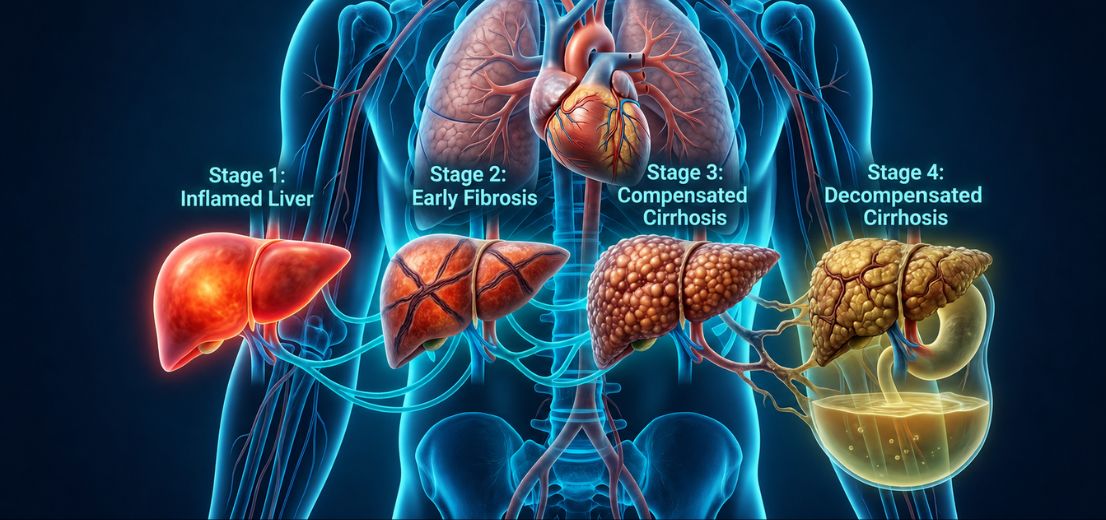
The liver becomes inflamed due to ongoing injury.
At this point, permanent scarring may not yet be extensive.
This may be the most important opportunity for intervention before significant fibrosis develops.
Scar tissue begins forming around liver tissue.
The liver can still function relatively well, but structural damage is becoming more noticeable.
Fibrosis represents a turning point where long-term damage becomes increasingly difficult to reverse.
?Significant scarring is present, but the liver still manages to perform most essential functions.
Many patients remain symptom-free.
Others may experience:
Without treatment, compensated cirrhosis may eventually progress to decompensated cirrhosis.
For an end-stage liver cirrhosis patient, complications such as ascites, internal bleeding, jaundice, and hepatic encephalopathy become significantly more common.
The liver can no longer adequately compensate for the damage.
This is often considered advanced or end-stage liver disease.
This stage carries the highest risk of complications, hospitalization, and liver failure.
Many patients searching for:
are usually referring to this phase of the disease.
As liver function declines, symptoms become increasingly difficult to ignore.
Yellowing of the skin and eyes due to bilirubin buildup.
This is also why patients sometimes search for:
Alcoholic Jaundice Life Expectancy
Jaundice itself does not determine survival, but it often signals advanced liver dysfunction.
Fluid accumulation within the abdomen.
Toxin buildup affecting brain function.
Symptoms may include:
Damaged blood vessels may rupture and cause internal bleeding.
Loss of muscle mass becomes increasingly common in advanced disease.
Many end-stage patients experience profound exhaustion and reduced mobility.
One of the biggest misconceptions about cirrhosis is that symptoms always appear early.
In reality, many people feel relatively normal for years.
That is why routine screening matters, particularly for individuals with:
Detecting fibrosis before advanced cirrhosis develops may significantly improve outcomes.
One of the most searched questions online is how long can you live with cirrhosis. The answer depends heavily on the stage of disease, the underlying cause, and how early treatment begins.
Many people also ask how long does cirrhosis take to kill you, but there is no single timeline. Some individuals live for many years with compensated cirrhosis, while others experience more rapid progression after complications develop.
Patients researching cirrhosis of the liver life expectancy should understand that early diagnosis and management often have a greater impact on outcomes than age alone.
Individuals with fatty liver disease frequently ask about life expectancy with fatty liver disease, especially after learning that fatty liver can progress into fibrosis and eventually cirrhosis. Not everyone with fatty liver develops advanced liver disease, but monitoring and treatment remain important.
In alcohol-related liver disease, patients sometimes search for information about the life expectancy. Jaundice may indicate significant liver dysfunction and should always be evaluated by a healthcare professional.
Blood Tests
Doctors often evaluate:
Ultrasound, CT scans, and MRI scans help assess liver structure.
Measures liver stiffness and fibrosis.
Sometimes used to confirm diagnosis and determine disease severity.
While cirrhosis itself is often difficult to fully reverse, treatment may slow progression and reduce complications.
Treatment depends on what caused the disease.
Examples include:
Doctors may prescribe medications to help manage:
For advanced disease, transplantation may become the most effective treatment option.
Researchers continue exploring new approaches aimed at:
Investigational therapies targeting fibrosis and inflammatory pathways remain active areas of research.
Understanding what are the 4 stages of cirrhosis of the liver can help patients recognize the disease before serious complications develop. Cirrhosis rarely appears overnight. In most cases, it progresses gradually through inflammation, fibrosis, compensated cirrhosis, and eventually decompensated cirrhosis if the underlying cause remains untreated.
Because symptoms may remain subtle for years, early detection continues to be one of the most important factors in managing liver disease. Regular monitoring, lifestyle changes, and treatment of underlying conditions may help slow progression and preserve liver function.
Researchers, including teams at Bioxytran, Inc., continue investigating fibrosis-related mechanisms and novel approaches that may support future innovation in chronic liver disease management.
Understanding the biology of cirrhosis starts with understanding fibrosis. Explore Bioxytran's ongoing research into Galectin-3, inflammation, and emerging approaches aimed at addressing chronic liver disease progression.
The four stages are inflammation, fibrosis, compensated cirrhosis, and decompensated cirrhosis.
Early symptoms may include fatigue, weakness, mild abdominal discomfort, and sometimes no noticeable symptoms at all.
Common causes include fatty liver disease, NASH/MASH, alcohol-related liver disease, chronic hepatitis infections, autoimmune disorders, and genetic conditions.
End-stage cirrhosis symptoms may include jaundice, ascites, confusion, gastrointestinal bleeding, muscle wasting, and severe fatigue.
Early fibrosis may improve if the underlying cause is addressed. Advanced cirrhosis is generally considered permanent, although treatment can help slow progression and manage complications.